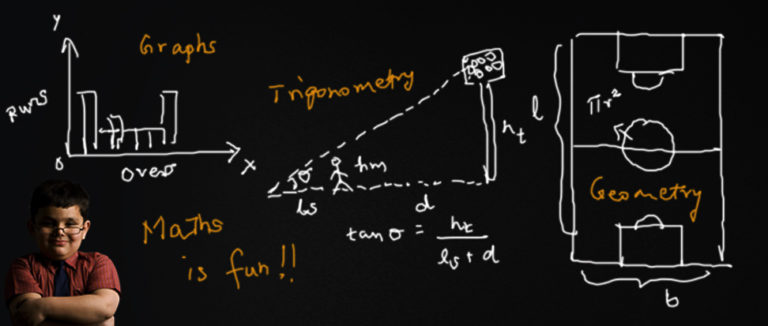
“When will I ever use this” is a phrase I hear on a daily basis from my students. Students think that they will never use the concepts that I’m teaching them. Look at sports- basketball for example. During the game of basketball there are many thoughts going through the player’s head. These thoughts require problem solving skills. Stats are being kept from the sidelines, which will then require calculations in order to find percentages. In my class I’m not only teaching problem solving and computation skills; I incorporate teamwork into my lessons as well. In the game of basketball winning can’t be done alone, it takes teamwork. Students think they don’t need the skills I’m teaching but yet they want to be good at sports, so let’s look at the application of mathematics in basketball.
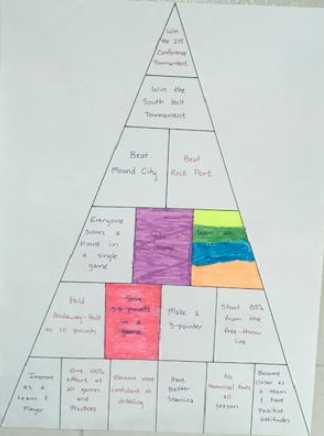
Math is used in basketball in a number of ways, from problem solving to geometry awareness. Even computations skills must be used in the game of basketball. For example, mathematical skills must be used when calculating the percentages, or the average of team or individual stats. Each year I make a list of goals for our team (pictured below). One goal is to shoot 85% from the free throw line. One must understand the concept of percentages and how to calculate percentages. My junior high team said, “We only missed 2 free throws tonight so we surely got that 85% goal, right?” I told them we only shot 6 free throws. Students need to understand that if we don’t shoot very many free throws then it only takes one or two misses to drop our percentage.
In my classroom I use our team free throw stats to teach percentages. I also teach percent change by comparing last year’s win/loss record to the current year. When teaching these concepts in class I have students work with a partner or a small group when investigating these because it teaches teamwork, which is an important skill in basketball as well as in life.
Geometry is one of the most important mathematical skills in basketball. Students need to become familiar with angles and degree measurements. This then leads to the next topic, the importance of the arc on a free throw or any shot on the court. In basketball the magic number is 45 degrees. A shot with an arc of 45 degrees will result in the most success. After students have a good understanding of angles then the more success they will find in the game of basketball.

When teaching my players to run our press break, I tell them they must v-cut to half court at a 45 degree angle. Without a 45 degree cut to the middle, the press breaker won’t work for a couple of reasons. Making a 45 degree angle is the quickest way to get there and it keeps the floor spaced. Students need to know what a 45 degree angle looks like. Also, when making long passes one must determine the speed and distance to throw the ball. This all requires mathematical calculations and problem solving. I know the player does not physically calculate this, but it is a learned skill that is built upon problem solving in the math classroom. As a coach I find myself asking, why is #12 always getting open under the basket? As a team they must problem solve and figure out why this is happening. They must work together to stop that player. Basketball is composed of teamwork and problem solving; both of these components are needed to become successful.
Personally, I like to relate my math problems to game stats. Students are more likely to understand mathematical concepts if they can make a personal connection to it. As an educator, if you connect real-life situations to math concepts students will be able to answer the question “When will I ever use this?” The following link provides additional examples of the application of math in sports https://www.slideshare.net/viru0913/application-of-mathematics-in-sports. Nearly every sport has mathematical concepts built into it and it helps students realize the importance of the mathematical skills they are learning.
To read more about the connection between mathematics and sports check back next week because I will be writing about making math relatable to students to increase student engagement. Student engagement is essential and I strongly believe that the more connections you make with a student the more successful they will become in your class. Making connections with your students will build strong student-teacher relationships, which is a key component in a successful education.
 Problem Solving Involves Teamwork