Coaches, when do you find time to grade papers?

Being a teacher and a coach is very hard at times. I get pulled in many directions between school, coaching, family needs, and working towards my masters. Between all of this I need some “me time.” Currently, junior high and high school basketball are overlapping so my schedule is crazy right now. But I love every moment and wouldn’t trade it for the world. Everything manages to get completed it just takes good time management skill, effort, and problem solving. 


The question I want to focus on is, when does a teacher/coach find time to grade papers?

As a math teacher I assign homework everyday. I want to provide feedback to my students in a timely manner so they know how they are performing. Below are three ways I go about grading papers:

1) In my Algebra 1 class, I have students grade their own assignments in class. Then we talk about the problems they missed. This allows for quick feedback.

2) Other times, I grade papers by myself while students are spending the last 10-15 minutes of class working on the lesson I just taught. 

3) Sometimes I grade based on participation. For example, if a student attempts all the assigned problems they get all the points. Pictured below are examples from two students. The first student attempted all the problems so he received 17 out of 17. The second student did not attempt all the problems; leading to a score of 10 out of 17. 


I would like to introduce Mrs. April Allen (or Coach Allen)

April teaches 10-12th grade mathematics at South Holt so we spend a lot of time discussing standards and expectations of students. April coaches high school softball and cheer for both varsity football and basketball. So she is also busy between balancing time between school, coaching, family, and time for herself. Below is her response to the question, how/when do you find time to grade papers

  • “In my class, most students’ grades are based on chapter tests.”
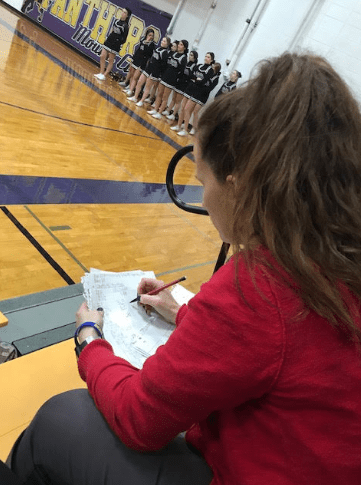
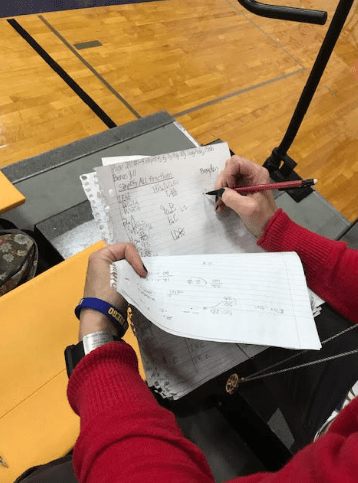
  • “When coaching high school cheer, I grade assignments at the game. I grade them at halftime and between the girls’ and boys’ games.” We are currently playing in a tournament this week so here are a couple pictures of her using her time wisely to grade papers.   
  • April also said, “The majority of the time, I have students grade their own papers in class.”
  • Her last statement in regards to this question was, “Sometimes I don’t even grade students’ assignments. I assign a lot of in class work therefore I do a lot of formative assessment by walking around watching students work. I watch for how they communicate with their “team” or peers. This helps me determine if students are understanding the topic. It also helps me assess student learning while cutting down on the papers I have to grade on my own time.”

My next question is, how do you think students would respond if homework was optional? By this I mean, homework wouldn’t be for a grade. In math, students learn by practicing so would students still do the assigned problems even if they don’t have to? Could this teach some accountability and put the responsibility of leaning more on the students?

  • April Allen’s response: “At a high school level, I think 80% of students would take self-control and do the assigned problems even if they didn’t have too. 
  • “For an incentive, you could tell students on the day of the test that they could use any homework they have completed to help them during the last 10 minutes of the test. This may encourage more students to complete the assigned problems or at least look over them each night.”

Along with my guest, April Allen, I would like to provide some more tricks for managing time when grading papers. If you find grading papers a hassle or too time consuming I highly suggest that you try some of the helpful hints described in the following article. These will be time savers which will result in more family or free time.  https://www.scholastic.com/teachers/articles/teaching-content/overwhelmed-grading-papers-try-these-time-saving-tricks/


You may be wondering how is this connected to “problem solving involves teamwork.” Not only do students need teachers; but teachers also need student’s help. It’s all about teamwork. By having students grade papers it is helping the teacher by allowing him/her more time to plan other lessons. It also benefits the students. It is a win-win situation. Students are able to get immediate feedback and this is a great time for them to ask questions about problems they missed. It also allows the students to think critically about the problems and understand why they missed the ones they did, and how to eliminate their mistakes on future problems. 


I would love to hear how you manage your time when grading papers. When do you grade papers? How do you grade them (participation, correct/incorrect)? Do you do weekly quizzes, with homework being optional? Is the homework you assign completed on a digital platform that grades for you? Drop your comments below. 

Building Positive Relationships

Building positive teacher-student relationships are an essential part of education. When students feel connected with their teachers, they are more likely to become successful in the math classroom and on the basketball court. 

To build positive relationships with my students I do a number of things: 

  • I attend students’ sporting events. They like seeing their teachers in the stands cheering them on. Students like to talk about the game the next day and you can comment on good things such as, “I saw that 3 pointer you made at the buzzer!” 
  • I notice when students get a haircut, or get new glasses, or something else changes. This shows the student that I recognize them. Each student stands out in their own way; they don’t blend into the crowd. 
  • I allow students to come to my classroom before school starts to visit. I get to hear what they did over the weekend or what they did last night. Sometimes students need someone to listen to them and that’s why my door is always open every morning. 
  • I congratulate students when they receive an award. 
  • This past September I ran in a 5k race with some of my students (and community members) because they like to see their teachers participate in things they enjoy. (pictured below)

One may ask, “How can you incorporate building positive teacher-student relationships into math curriculum and coaching?” Keep reading and I’ll tell you how. 

I teach in a rural community so I have several students who like to hunt and fish and I too enjoy both of these. It is currently deer season so to build relationships with these students I check up on these students asking if they saw anything or got a deer. Even if they didn’t get a deer they always have stories to tell me. To connect deer hunting to math curriculum we discuss how to score a buck’s antlers. I told a student if he gets a deer to bring in the antlers and we can score it. In order to do this, I would have to teach students how to read a measuring tape accurately. Students would also have to know or learn how to add and subtract decimals or fractions. When scoring a deer’s antlers, I would have the students work in groups of three to promote teamwork. Each student in the group would have a specific job, such as “the measurer”, “the recorder”, and “the calculator”. To help them in the scoring process, I would refer them to the website:  https://shootingtime.com/hunting/how-to-score-a-buck/ . By doing this activity, students would be incorporating computational math skills, problem solving, and teamwork all while building a relationship with their teacher. 

But not all of my students are hunters so I would transition my lesson to what they enjoy, such using Snapchat. I have Snapchat but it is very private and I only have close friends, NO STUDENTS! To build a relationship with my students, we discuss the benefits (and harms) of Snapchat. Students like to talk about all the cool things you can do with it and they end up teaching me new things. Students like when teachers are able to relate to what they like. I coach junior high girls’ basketball and they said they use Snapchat to remind each other of important basketball information; it is their main form of communication. To relate Snapchat to the math world, we discuss how Snapchat can be useful in solving math problems. There is now a new feature that allows you to scan a math problem and it not only gives you the answer but it provides you with the steps to solve it (shown below). If used properly this can be a helpful resource if students get stuck on their homework. The more connections you can make with your students, the better relationships you will make. 

Building relationships with students does not mean you have to be their friend. In fact you can’t be their friend on any form of social media; otherwise your digital reputation could be destroyed. Nor should you become friends with student’s parents because this can bring fuel to the fire if something would occur. If you want to connect to your students through social media it should be through a school site that only posts information about school related activities, such as school Twitter or Facebook accounts. Even when using these you need to act professionally when making connections to your students. Building relationships means getting to know your students but not only through the social media world. To protect your reputation, be aware of what you post on social media (even on the school site). Make sure that you have a student’s consent before you post student’s pictures on social media, there are many eyes looking at these posts so you want to protect the reputation of everyone involved. 

Application of Mathematics in Sports

“When will I ever use this” is a phrase I hear on a daily basis from my students. Students think that they will never use the concepts that I’m teaching them. Look at sports- basketball for example. During the game of basketball there are many thoughts going through the player’s head. These thoughts require problem solving skills. Stats are being kept from the sidelines, which will then require calculations in order to find percentages. In my class I’m not only teaching problem solving and computation skills; I incorporate teamwork into my lessons as well. In the game of basketball winning can’t be done alone, it takes teamwork. Students think they don’t need the skills I’m teaching but yet they want to be good at sports, so let’s look at the application of mathematics in basketball. 

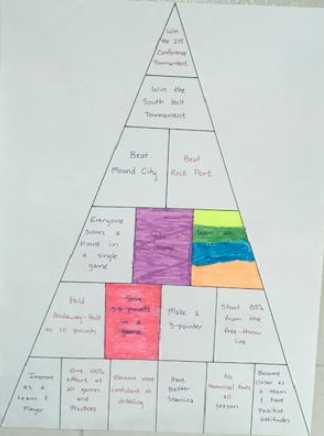
Math is used in basketball in a number of ways, from problem solving to geometry awareness. Even computations skills must be used in the game of basketball. For example, mathematical skills must be used when calculating the percentages, or the average of team or individual stats. Each year I make a list of goals for our team (pictured below). One goal is to shoot 85% from the free throw line. One must understand the concept of percentages and how to calculate percentages. My junior high team said, “We only missed 2 free throws tonight so we surely got that 85% goal, right?” I told them we only shot 6 free throws. Students need to understand that if we don’t shoot very many free throws then it only takes one or two misses to drop our percentage. 

In my classroom I use our team free throw stats to teach percentages. I also teach percent change by comparing last year’s win/loss record to the current year. When teaching these concepts in class I have students work with a partner or a small group when investigating these because it teaches teamwork, which is an important skill in basketball as well as in life. 

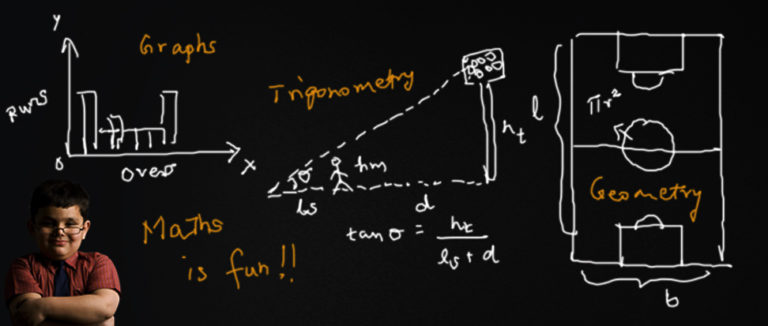
Geometry is one of the most important mathematical skills in basketball. Students need to become familiar with angles and degree measurements. This then leads to the next topic, the importance of the arc on a free throw or any shot on the court. In basketball the magic number is 45 degrees. A shot with an arc of 45 degrees will result in the most success. After students have a good understanding of angles then the more success they will find in the game of basketball. 

When teaching my players to run our press break, I tell them they must v-cut to half court at a 45 degree angle. Without a 45 degree cut to the middle, the press breaker won’t work for a couple of reasons. Making a 45 degree angle is the quickest way to get there and it keeps the floor spaced. Students need to know what a 45 degree angle looks like. Also, when making long passes one must determine the speed and distance to throw the ball. This all requires mathematical calculations and problem solving. I know the player does not physically calculate this, but it is a learned skill that is built upon problem solving in the math classroom. As a coach I find myself asking, why is #12 always getting open under the basket? As a team they must problem solve and figure out why this is happening. They must work together to stop that player. Basketball is composed of teamwork and problem solving; both of these components are needed to become successful.

Personally, I like to relate my math problems to game stats. Students are more likely to understand mathematical concepts if they can make a personal connection to it. As an educator, if you connect real-life situations to math concepts students will be able to answer the question “When will I ever use this?”  The following link provides additional examples of the application of math in sports https://www.slideshare.net/viru0913/application-of-mathematics-in-sports. Nearly every sport has mathematical concepts built into it and it helps students realize the importance of the mathematical skills they are learning. 

To read more about the connection between mathematics and sports check back next week because I will be writing about making math relatable to students to increase student engagement. Student engagement is essential and I strongly believe that the more connections you make with a student the more successful they will become in your class. Making connections with your students will build strong student-teacher relationships, which is a key component in a successful education. 

Site Explanation

My purpose for this blog is to share my love for both teaching mathematics and coaching. These two areas drive me to get out of bed each morning knowing that each day I am able to impact and transform a student’s life. Throughout this blog, I will be sharing my day to day experiences, hoping to encourage others to see the impact teaching and coaching has on young individuals.

I’m just getting this new blog going, so stay tuned for more!

Subscribe below to get notified when I post new updates.

About Me

I am Michelle Schulte. I currently teach 7-9th grade mathematics at South Holt, in Oregon, MO. I am the head coach for junior high girls basketball, assistant coach for high school girls basketball, and head coach for 7-8th grade boys and girls track and field. This is my 4th year of teaching and coaching and I have loved every minute of it! In my spare time, I enjoy spending time outside, golfing, kayaking, running, and traveling.

This is my first blog ever! So I’m still learning all the tools and functions. I never thought I’d become a blogger, but what do you know, things change!

My topic of focus will be teaching and coaching. I will be blogging about how problem solving and teamwork are intertwined. Through this blog, I would love to connect with educators, coaches, and others who are interested in shaping the lives of students.

Design a site like this with WordPress.com
Get started